 After three years helping out at the Hardman, the one thing I have learned about this full-distance triathlon is that there is no Hardman. When all you know about full-distance triathlons is that they involve an insane amount of voluntarily inflicted physical punishment, you assume that everyone who turns up at registration will be a testosterone-pumped Colossus with muscles bigger than your head. Nothing could be further from the truth. Registration turns up a motley crew of bodies, some of whom I used to assume were collecting numbers for other people. Now I know better.
In the beginning…
At 5:30 on a Saturday morning in late August, I’m yawning into my high-viz jacket while they are racking their bikes and dropping off the fuel that will keep some of them going until 11.30 that night. I’m staring down a big black lake with slithering dark waves while they are zipping up their wetsuits and contemplate swimming 3.8km around it. It’s good to have your preconceptions shattered every now and then.
By 6 am, the lake has discovered its happy face, and 82 people are lining up to feel it from the inside. Then Jules strikes up the theme tune to The Lion King, and they’re off. Well, some of them are. There is always that instant when you see paralysis set in, those few moments when you see the heads at the back bob for what seems like forever, and you will them to go on, to just put their faces into the black-dark water and do what they have been getting up to do in the black-dark mornings for months now. And, eventually, they do. They strike out for the bright yellow buoy, and you breathe again.
Water Marks
As the first lap approached, it was clear to see there were two clear leaders, the second slashing at the first swimmer’s shoulders, clear water between them and the third competitor. As the second and final lap ended, they remained without rivals, and when we pulled them out, we discovered that the first Hardman out of the water was a woman, from The Beards team. (And not to make a big deal out of it or anything, but the third person to conquer the lake was also female).
I love pulling people out of the water. That is not at all as grim as it sounds: You really never know what you are going to get. Sometimes you see a great white shark powering toward you, and when you hold out a hand to help them onto dry land, they collapse ontothe ramp like a newborn calf. Other times, a head bobs up from the water with a jaunty “how’re ya?,” and some little water nymph skips along the pier as if they had just popped out for the papers. Every time I grab a water-wizened hand and clap a neoprened shoulder, I feel relief and awe for another lake conqueror. My family does not have a good history with that lake, so it always feels good to welcome another competitor back to land.
Park Life
By the 2:20 cutoff, there was just one competitor left in the water, and, once he was persuaded onto the rib, the water section was safely over for another year. Transition is Hugh Carbery’s specialty, something he manages with military precision. T1 and T2 are his territory. My turf is Queen’s Bridge, in the national park. By the time I saw another competitor, it was 12:45 and the third member of the Beard team was passing the water stop that Tess and I would manage for the next eight or so hours. Peter Kern, the hot favourite was second, and then it was the turn of Brian Sexton, runner up and contender for nicest man in Sligo for the past two years. Then there was a very long gap before we see anybody else, besides a constant stream of jaunting cars asking are we serving Guinness/vodka/poitin in our plastic cups. I have never seen so many jaunting cars clogging up the paths, plamásing the tourists with stories of brown trout and leprechauns, while runners and walkers and cyclists try to get around them. Some of them were not that lucky. At one point, we looked up to see a Garda paddy wagon closely followed by an ambulance attempting to negotiate the path leading to the river. We later learned that a visitor had been knocked off his bike by one of the jarveys and had his knee split open. But hey, they are part of Killarney’s culture.
The Hard People
Back to the race: By lap two, Peter Kern was walking. It looked like the bridesmaid might be bumped up the rankings. In the meantime, the great and the good that make up the Hardman pack were rocking up to our station in all their wonderful guises. Darragh from Cork was there, of course; it would be almost rude for him not to turn up at this stage. The ever-smiling Graeme from South Africa had returned after his win in the water last year. And the women! Thirteen female competitors, when the most we had ever had before was three. The farmers at the food stop in Waterville must have been thrilled.
By 11.30, it was getting lonely. Dan, three-time Hardman starter, part-time thespian, and full-time good guy shouted “Runner!” for the last time, and we could go home. 2017 Hardman Brian Sexton had been home for something like seven hours (though, being the nice guy he is, he had come back and stayed late to cheer on the other finishers). The original Hardman, Alan, had another few hours to go, collecting rubbish and signs and packing things away until next time, but for Hugh, Brenda, Sive, Adrian, Trish, Terry, Florence, and the rest of us, it was time to crash, slightly embarrassed at feeling exhausted when we hadn’t even swum 3.8km, cycled 180km or run 42.2km.
Shock and Awe (Mainly Awe)
That’s why I say there is no Hardman. They are all Hardmen—from “the young bucks” from Barcelona who cycled here to compete (and then stayed in a tent) to Billie McSweeney from Killarney, who knocked almost an hour off his best time without a single member of his tri club to witness it, and Bernie from Loughrea with the luminous nails who borrowed my head torch but left it with her run gear and almost lost her life when a red deer leapt in front of her in the dusk. Short tall, ripped, or well-upholstered, they prove yet again that the human spirit is what gets you over the line.
Can’t wait until next year.

 Like an endless game of ping-pong, the cars chug the couple of kilometres from Manger Square to the checkpoint and back again. As our hotel owner’s wife informed us with a weary shrug, “They have nothing else to do. They want to bring their families out on a Saturday evening, so they drive up and down from the square to the checkpoint. They can’t go any further.”
 So Saturday night fun for Bethlehem residents without permits revolves around driving to the separation wall and back to Manger Square, that near-mythical spot recreated with dolls and dish cloths in nativity plays across the world each Christmas. We sat in the window of a restaurant, feasting on hummus and falafel and watching the procession of cars, everything from ancient bangers rumbling along in a clatter of dust and prayers to new model Mustangs and a cherry-red open-top BMW driven by a teenager who waved like a passing monarch. “He stole the keys while his father slept,” sneered our luxuriantly mustachioed restaurant manager.
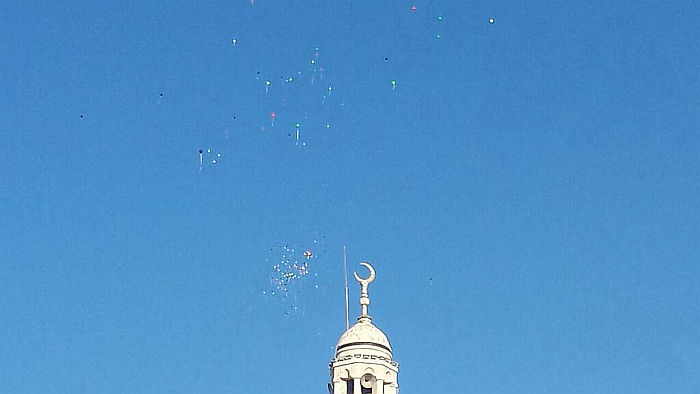
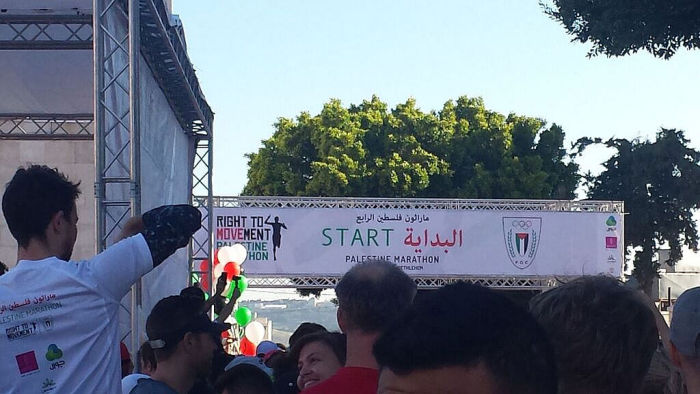 We gathered in Manger Square on the morning of the race, dance versions of Adele and Justin Bieber pounding as announcements rang out in English and Arabic, and balloons of green, white, red, and black drifted high above the mosque and disappeared in a flawless blue sky. Atmospheres at the start of races are often tense, expectant, charged with the energy of a thousand GPS watches being synchronized, but this was different. Joy and excitement radiated through the crowd of 4,371 participants, most of them signed up for the 10km event, many of them swathed in winter coats and burkas, their race numbers barely visible amid the layers. Once the race started, they swarmed down the street like kids let out from school, many of them gasping and panting before they got to the bottom of the hill. But it didn’t matter; they were not there to win.
 When I got back to the hotel, I downed the Turkish coffee that our host offers at every opportunity and clapped and cheered runners on their third round of the route. Their faces and bodies were slick and haggard from the baking heat of the furthest point of the course, high in the open plains of the outskirts of the city, where the residents of two refugee camps eke out an existence. I heard afterward that, whereas the kids held out their palms for high fives and ran alongside the runners on the first leg of the marathon, by the time the runners were leaving the camps behind for the final time, the bored children were firing rotten fruit and pebbles.
 I know I should be grateful. I know it could be a lot worse. I know this is a relatively minor setback in the grand scheme of things.


